Your listing & AI search
Writing a listing an AI assistant can read
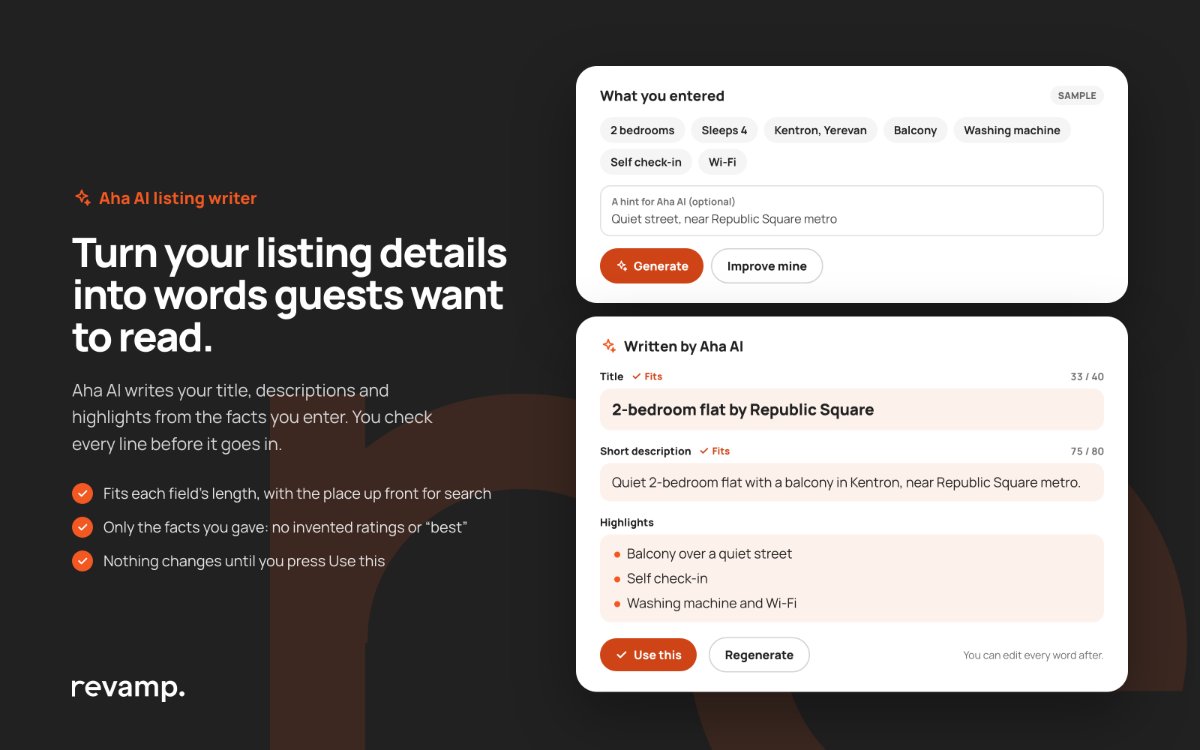
An AI assistant can only recommend you for what it can read about you. If your listing says "cosy flat in the heart of the city", the assistant has nothing to repeat when a guest asks for "a two-bedroom near Republic Square with parking and air conditioning". If it says exactly that, you're a match.
This guide shows how to write a listing, on Revamp and on every other site, that an assistant can read and repeat correctly. It builds on Writing a listing that gets booked, and uses Google's own guidance for site owners at the time of writing (November 2026). Revamp is not affiliated with Google, OpenAI, Anthropic or Perplexity.
The short answer
Write facts, not adjectives. Say who the place or tour is for, where exactly it is, what's included and what isn't, how to get there and what the rules are. Answer the questions guests always ask. Keep the same facts everywhere you're listed. Add what only you know, from first-hand experience. If an AI tool helps you write, check every line before you publish.
Facts an assistant can repeat
Guests ask assistants specific questions, so give specific answers.
For a stay
- Who it suits: couples, families, remote workers, groups
- Exactly where: the district or street, and minutes on foot or by car to two or three places guests care about
- Sleeping: bedrooms, beds and their sizes, sofa beds, how many guests
- What's there: kitchen, washing machine, air conditioning, heating, workspace, lift, balcony, parking
- Getting in: floor, stairs, step-free entrance, self check-in
- Rules: check-in and check-out times, children, pets, smoking, quiet hours
- Languages you speak
For a tour or experience
- What happens, in order, and how long it takes
- Where it starts and ends, and whether pick-up is included
- What's included and what isn't: transport, tickets, food, wine
- Group size, difficulty, minimum age and what to bring
- Languages and the cancellation terms
Adjectives versus facts
Compare two descriptions of the same flat:
- Vague: "A stunning, cosy apartment in the heart of Yerevan, perfect for your stay."
- Readable: "A two-bedroom flat on the 4th floor (lift) of a quiet building on Tumanyan Street, 6 minutes' walk from Republic Square. Sleeps 4 in a double and two singles. Air conditioning, fast Wi-Fi, a full kitchen and a washing machine. Free street parking. Self check-in from 14:00."
The second one answers a dozen possible questions. The first answers none.
Numbers help too, if they're true: minutes on foot, square metres, the floor, the year the bathroom was renovated. Never round up. Guests rate accuracy after the stay, and an assistant repeating a wrong fact makes it look like your mistake.
Answer the questions guests always ask
Every host gets the same questions: Is there parking? Can I check in late? Is it quiet at night? How do I get there from the airport? Is the tour suitable for children?
Put the answers on the listing itself, not only in messages. Assistants can read your listing; they can't read your inbox.
On Revamp, your listing's "Questions guests ask" section is drafted for you from the details you've entered, and you can edit it in Dashboard → Listings → Guest FAQ. Revamp's AI tools answer guests from those same details, so every field you fill in is something they can say.
The same facts everywhere
Assistants read several sources about you: booking sites, Google, your own website. When those disagree, they may pick the wrong one, or trust none of them.
Google's guidelines ask businesses to represent themselves "as it's consistently represented and recognized in the real world", with one name, one address and one main phone number and website. Apply the same rule across every site you're listed on:
- Name. The same name everywhere. Not "Ani's Flat" on one site and "Cascade Apartment" on another
- Address and map pin. The same, and accurate
- Capacity, beds and rooms. The same numbers
- Check-in and check-out times. The same
- Key amenities. Parking, air conditioning or a pool shouldn't appear on one site and not another
Once a year, open each listing side by side and fix the differences. Your reputation beyond one booking site covers keeping reviews and replies consistent too.
What only you know
Google's own guidance for its AI answers says original, first-hand content is more useful than a summary of what others have said, and warns against just recycling what's already on the internet.
That's an advantage for hosts. A few lines only you could write:
- The bakery downstairs that opens at 7
- How to reach the guesthouse after snow, and whether you'll collect guests from the bus
- Which day the market is busiest, or the best time to reach the monastery before the tour buses
Add them to your description, your house guide or your tour notes.
Photos and captions
Assistants read text more easily than pictures. Give your photos short, plain captions that say what they show: "Second bedroom, two single beds", "View of Mount Ararat from the balcony on a clear morning". On Revamp, captions are also used as the photos' text description. How to get great listing photos covers the photos themselves.
Structured data on your own website
Structured data is code on a web page that labels facts, such as your address, prices or number of rooms, so machines read them reliably.
- Google says it isn't required for its AI answers, and there's no special markup to add
- Its holiday-rental rich results only work for sites already connected to Google through its partner programme
- If you use it, it must match what the page shows. Google says not to mark up anything readers can't see, or fake reviews
Revamp adds this markup to your listing pages for you, from your listing's own details, and never adds ratings we don't have.
If AI helps you write
Using an AI tool to draft your description is fine. Google says generative AI can help add structure to original content, and that it's "critical to manually factcheck and review all AI-generated content" before publishing. AI tools fill gaps with likely-sounding details: a pool, a view, "five minutes from the centre". Delete anything that isn't true.
Chapter 3 covers the rules each booking site sets for AI-written text, photos and replies.
Mistakes to avoid
- Adjectives instead of facts
- Different names, beds or check-in times on different sites
- Answers that only live in your messages
- Rounding distances down or sizes up
- Publishing AI-written text without checking every line
- Photos with no captions
Your checklist
Your listing
- Who it's for, exact location, rooms and beds, key amenities
- Getting there, getting in, rules, languages
- The five questions you're asked most, answered on the listing
- Two or three things only you would know
Everywhere you're listed
- Same name, address, capacity, times and amenities
- Checked side by side once a year
On Revamp
- Every field in the listing form filled in
- Guest FAQ checked and edited
- Photo captions added
Questions hosts ask
Do I need to write differently for AI than for guests?
No. Clear, specific, honest facts work for both. Google says optimising for its AI answers is "still SEO".
Will a longer description rank better?
Not because it's longer. It helps when it adds facts guests need, not when it adds words.
Should I list every amenity I have?
Every true one, yes, in the amenity list rather than buried in a paragraph. Never one you don't have.
Does Revamp share my private details with AI assistants?
No. Door codes, Wi-Fi passwords and your phone number stay out of the public listing; they reach guests only in the messages before arrival.