Pricing & your numbers
Knowing your market: comparison sets and market data
Your own numbers tell you how your month went. They can't tell you whether the whole market had a slow month or only you did. For that you need to look outside: at the places guests compare you with, and at the bigger signals for Armenia.
This guide shows you how to build a comparison set that is actually fair, where market data comes from, and what each source can and can't tell you. The aim isn't more data. It's knowing which source answers which question.
The short answer
Pick 8 to 12 places that guests would really weigh against yours, and check them the same way every month. Then use outside data for the bigger picture: market figures for your town, flights to Armenia, official visitor counts and busy dates. Each source answers one question well and others badly. Your own pace still comes first; outside data helps you understand it.
Build a fair comparison set
A comparison set is the group of places a guest sees beside yours in the same search. The first-season pricing guide used a quick list to set a starting price. For reading the market, choose more carefully.
- Same guests. The same number of guests and a similar number of bedrooms.
- Same location, as guests see it. Places a guest would think of as the same area, not the same district on paper.
- Same standard. Similar finish, photos and review score.
- Same must-haves. If you offer parking, air conditioning or a proper workspace, compare with places that have them too.
- Places that sell. A listing that sits open all summer at a low price may not be a competitor at all.
Keep a separate set for each kind of property you run. A studio and a three-bedroom house don't share a market, even on the same street.
What to record from your set
Check your set on the same day each month, and write down the same things.
- The total price for the same dates, cleaning fee included, for a weekday and a weekend about a month ahead.
- The minimum stay each place asks for.
- Which dates are no longer available in the next two months.
- Anything new: a place that opened, closed or changed its photos.
Be careful with closed dates. A date that isn't available may be booked, or the host may have blocked it. Treat one closed date as a hint, not proof. The pattern over several months, which dates close first and how early, tells you far more than any single price.
Market figures: the Market researcher
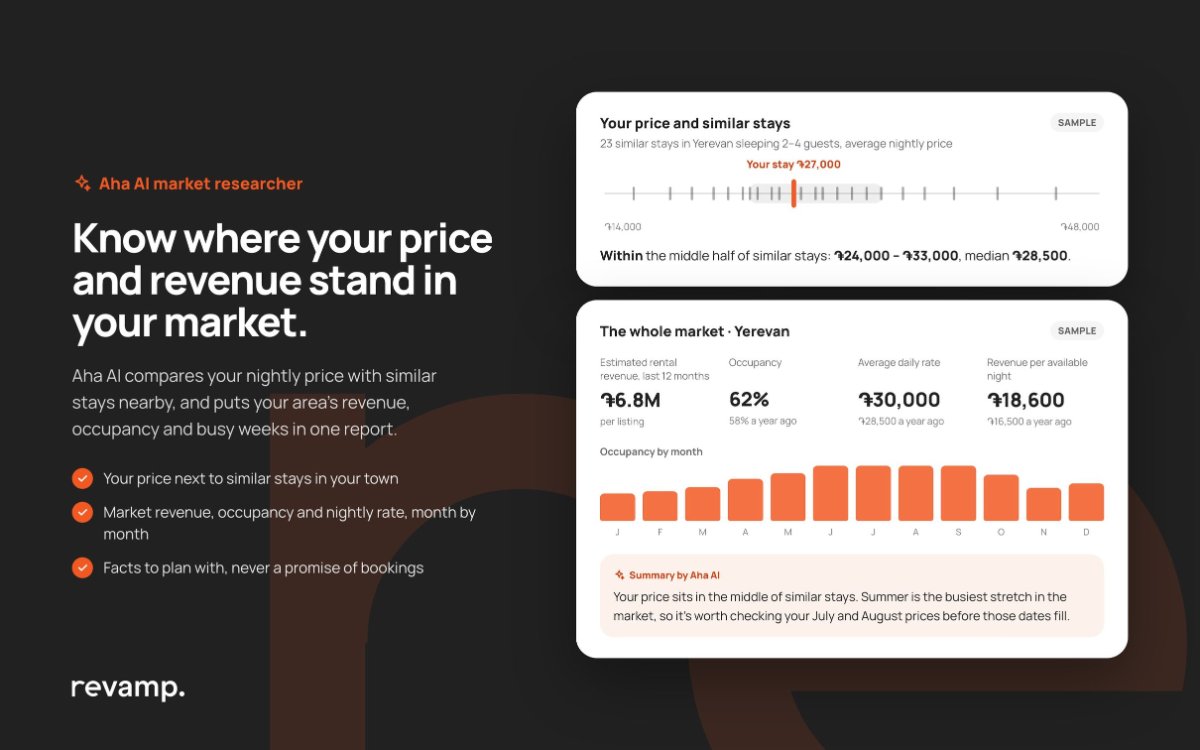
If you host on Revamp, Dashboard → AI Agents has the Market researcher: a report on one of your stays. Each run uses Aha AI credits, and the agent's card shows what it costs.
What it can show
- Your price beside similar Revamp stays in your city, as a range with no names or links, when there are at least 3 such stays from at least 2 hosts
- Whole-market figures for your town where Revamp has published them: PriceLabs market data, used with permission, such as estimated occupancy, ADR and RevPAR for the short-term rentals PriceLabs tracks
- The amenities that booked stays in your town have in common, also from PriceLabs, marked as listed or not listed on your stay
- Your calendar, busy dates ahead, the demand outlook, visitor numbers, flights and the dram
What it can't do
- Tell you what to charge. Its figures come from fixed rules, and Aha AI only writes the summary.
- Show figures for a town where none have been published.
- Promise that an amenity brings bookings. It shows what booked stays have in common, nothing more.
PriceLabs figures are estimates for the area PriceLabs tracks. Use them for direction, not as an exact count.
Flights to Armenia
The Market researcher also counts flights, week by week, from Zvartnots airport's own flight board, and from Shirak's for stays around Gyumri. It shows arrivals, the countries flights come from, airlines, new routes, and the same week a year earlier once a year of history has built up. Passenger figures from the Civil Aviation Committee are added after an admin checks them, and they run about a year behind.
What flights can tell you: whether more or fewer flights are coming, and from where. A new route from a country is an early sign of new guests.
What they can't: flights are not seats and not guests. The board doesn't show aircraft sizes, so ten small planes and ten large ones count the same.
Visitor numbers
Armenia in numbers shows official counts of visitors to Armenia from the Statistical Committee, quarter by quarter, with the latest months below. The Statistical Committee counted 453,138 visitors in January to March 2026, against 386,741 in January to March 2025. For April to June it counted 588,460, against 520,394 a year earlier.
Notice the comparison: the same quarter, a year apart. That is the fair test, for the country and for you. The page also shows who comes when and a marked forecast for the next quarters.
What visitor numbers can tell you: the direction of the whole country, and the shape of its seasons.
What they can't: anything about your street or your kind of property. Not every visitor stays in a short-term rental, and official counts are published months after the quarter ends.
Busy dates
Busy dates lists the big events and public holidays in Armenia, each with its source.
What it can tell you: which dates to price first, and early.
What it can't: how many guests an event brings, or whether they reach your area. A concert in Yerevan matters more to a flat in the centre than to a house in Dilijan.
Putting the sources together
Match the question to the source.
- Am I priced in line with places like mine? Your comparison set, and the Market researcher's price range.
- Is my month weak, or is everyone's? Your RevPAR beside your town's market figures where they exist, and how fast your set's dates closed.
- Is a strong season coming? Flights and visitor numbers for direction, Busy dates for the specific dates.
- Should I change a price today? Your own pace first. Outside data explains your pace; it doesn't replace it.
Some sources move fast and some slowly. A flight board changes week by week. Official visitor counts arrive months later. Use the slow ones to understand seasons and years, and the fast ones, with your own pace, for the weeks ahead.
Market reading mistakes to avoid
- Comparing with the cheapest place nearby instead of the most similar
- Treating every closed date as a booking
- Reading national visitor numbers as your own demand
- Treating flights as guests
- Copying a market average price that includes places unlike yours
- Changing your prices because of one data point
Your checklist
Your comparison set
- 8 to 12 places guests would really compare with yours
- A separate set for each kind of property
- Checked on the same day each month
Market data
- Your town's figures read for direction, with their source
- Flights and visitor numbers compared with a year earlier
- Busy dates checked for the next six months
Before you act
- Your own pace checked first
- One question, one source
Questions hosts ask
How many places should be in my comparison set?
Eight to twelve is enough to see a pattern. In a small town you may only find five. Fewer, truly similar places beat a long list of different ones.
My town has no market figures. What do I use?
Your comparison set and your own pace. They are often enough. Revamp's whole-market figures appear only for towns where they have been published.
Should I price at the market average?
No. An average mixes places that are better and worse than yours. Use it to see where the market is moving, and your comparison set to see where you stand.
How often should I rebuild my set?
Check it every month and rebuild it each season, or sooner if a strong new place opens nearby.