Your listing & AI search
How AI assistants find places to recommend
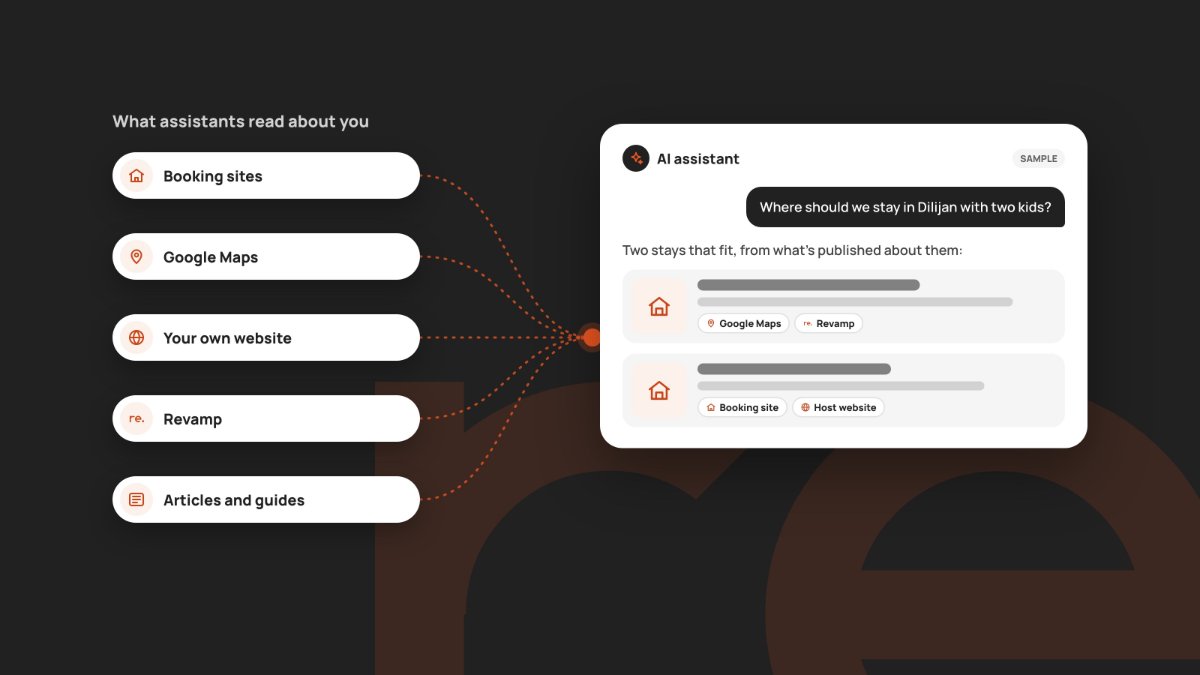
More guests now start a trip by asking an assistant: "find me a quiet place in Dilijan for two" or "what's a good wine tour from Yerevan?". The assistant answers with a few names and links. If your place or tour isn't one of them, that guest may never see you.
This guide explains what ChatGPT, Google, Claude and Perplexity themselves say about how they find and recommend places, and what that means for you. It uses only the companies' own help pages and blogs, plus reports of what the big booking sites told investors, at the time of writing (November 2026). This changes fast. Revamp is not affiliated with any of these companies.
The short answer
AI assistants don't keep their own list of places. When a guest asks, they search the web, read what they find (booking sites, Google Maps, your own website) and recommend from that, with links. So they can only recommend what they can find and read. Today they still send very few bookings: Booking.com says well under 1% of its room nights come from them. But more and more trips start there. Be easy to find in the places they read, keep your facts the same everywhere, and don't pay anyone who promises to "rank you in ChatGPT".
How each assistant finds places
ChatGPT
OpenAI's help page says ChatGPT search rewrites a question into search queries, uses outside search providers, and ranks the results on many factors, with "placement not guaranteed". Answers that use the web carry links to their sources.
- Booking.com and Expedia have apps inside ChatGPT since October 2025, so ChatGPT can show their listings when it suits the question
- Skift reported in March 2026 that OpenAI stepped back from booking inside ChatGPT, to focus on discovery. Hotel apps now hand the guest over to the brand's own site to book
- On 10 November 2026 OpenAI launched "Businesses in ChatGPT" in beta, where an eligible business can claim its profile through Business Hub
Google: AI Overviews and AI Mode
Google says its AI answers rest on the same ranking and quality systems as normal search, and that there's nothing extra to do to appear in them: "still SEO", in Google's words. It names Google Business Profile as one way local businesses become visible in AI answers. For travel plans, Google says it draws on Google Maps photos and reviews alongside sites from across the web.
Since August 2026 Google has been rolling out hotel booking inside AI Mode, in the US and in English, with large partners such as Booking.com, Expedia, Marriott and Hilton.
Claude
Anthropic says Claude searches the web when it helps and that every answer that uses search includes citations to its sources.
Perplexity
Perplexity says it searches the internet in real time and that each answer has numbered citations to the original sources.
Search crawlers and training crawlers
Each company sends programs that read websites. Some read pages so the assistant can show them in answers; others collect text to train future models. They're separate, and you can allow one and block the other.
- For answers (search): OAI-SearchBot (ChatGPT), Claude-SearchBot (Claude), PerplexityBot (Perplexity), Googlebot (Google)
- For training: GPTBot (OpenAI), ClaudeBot (Anthropic), Google-Extended (Google)
OpenAI says a site that blocks OAI-SearchBot won't be shown in ChatGPT search answers. Anthropic says blocking Claude-SearchBot may reduce your visibility in Claude's answers. Blocking a training crawler doesn't remove you from answers.
If you have your own website, ask whoever runs it to check that the site's robots.txt file and any firewall don't block the search crawlers. Some hosting and security services block them by default.
How much it matters today
So far, not much in bookings, but it's growing:
- Booking.com told investors in November 2026 that referrals from AI assistants have picked up but are still well under 1% of its room nights (its finance chief, as reported by PhocusWire)
- Expedia's chief executive said in November 2026 that AI's real strength is in discovery, but that people still want to book with a brand they trust
- Airbnb said in November 2026 that general AI assistants bring it little traffic so far, and that it will start rolling out its own AI travel agent in the first half of 2027
The pattern: guests use assistants to explore and shortlist, then book on a site they trust. So the work is to be on the shortlist, and to be easy to book once you are.
What the assistants read about you
Put together, an assistant answering a question about your area is likely to read:
- The big booking sites, directly or through their apps. Your listings there are your main public record
- Google Maps and Google Business Profile, with your reviews and photos
- Your own website, if you have one
- Revamp, if you list with us (below)
- Articles and guides that mention you, from local media to travel blogs
Google adds a point worth keeping: content written from first-hand experience is more useful than a summary of what others said. A host who explains how to reach the guesthouse in winter, or which wine to try with dinner, offers exactly that.
On Revamp
Revamp makes your listing easy for assistants to read:
- Our pages are served in plain, readable form to the search crawlers of ChatGPT, Claude, Perplexity and Google, with your listing's facts, photos and price
- Travellers can add Revamp to Claude or ChatGPT (see revampvacations.com/ai). Revamp then answers inside their chat with real listings, live availability and the full price for their dates, and they book on Revamp
- Your listing's details and its "Questions guests ask" are what that connector and Aha AI answer from
So the details you fill in on Revamp are the facts an assistant can repeat. Chapter 2 shows how to write them.
Things you don't need
- llms.txt. It's a proposed file that some sites add for AI tools. Google says its search ignores it, and it neither helps nor harms you there
- Special "AI markup". Google says no special schema is needed for its AI answers
- Anyone promising a top spot in ChatGPT. No company sells that, and Google warns that chasing fake "mentions" across the web isn't as helpful as it might seem
Mistakes to avoid
- Assuming guests will find you without being on the main booking sites or Google Maps
- Different names, addresses or facts on different sites
- A website that blocks search crawlers by accident
- Paying for "AI ranking" services
- Ignoring Google reviews because "nobody books on Google"
Your checklist
Where you're found
- Listed on the booking sites your guests use
- Google Business Profile claimed and complete, if you can have one: guesthouses, hotels and tour operators can, a single private apartment can't (chapter 4)
- Same name, address and key facts everywhere
Your website, if you have one
- Search crawlers not blocked in robots.txt or by your host
- Pages readable without logging in
Once a month
- Ask ChatGPT, Claude or Google for a place like yours in your town, and see who comes up and why
Questions hosts ask
Can I pay to appear in ChatGPT answers?
Not in the way people promise. OpenAI says placement in search answers isn't guaranteed, and nobody outside OpenAI can promise it. Spend the money on a better listing instead.
Should I block AI crawlers to protect my content?
Block training crawlers if you like. Blocking the search crawlers means the assistants can't show your site in answers.
Do AI assistants book stays directly?
Mostly not yet. They help guests explore and shortlist, then send them to a booking site or the property. Google has started hotel booking in AI Mode in the US with large partners.
Is Revamp in the ChatGPT and Claude app directories?
Not yet. Travellers can already add Revamp by hand, following the steps at revampvacations.com/ai.
Does Revamp know how the assistants choose?
No. Revamp is not affiliated with OpenAI, Google, Anthropic or Perplexity. This guide only explains what they publish at the time of writing.